
Faculty of Arts and Sciences
About the Faculty
The Faculty of Arts and Sciences (FAS) at AUB Mediterraneo is grounded in the American liberal arts tradition that has shaped the American University of Beirut since 1866. It offers undergraduate programs across the arts, sciences, and interdisciplinary fields, and oversees the General Education curriculum that forms a central part of every undergraduate education. Through this curriculum, the Faculty fosters critical thinking, ethical engagement, and global citizenship.
Through interdisciplinary learning, close faculty mentorship, and a strong emphasis on writing, research, and inquiry, students develop the intellectual breadth and practical capabilities to navigate complexity in a rapidly changing world, address pressing regional and global challenges, and pursue meaningful professional and academic pathways.
Institute for the Liberal Arts
At the heart of the Faculty of Arts and Sciences is the Institute for the Liberal Arts, which delivers the General Education curriculum and supports the liberal arts experience across the university.

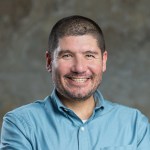
Meet the Dean

Our faculty traces its roots to the oldest faculty at the American University of Beirut, founded in 1866 as the Literary Department. At AUB Mediterraneo, we carry this liberal arts tradition forward in a Mediterranean context where questions of culture, history, science, technology, and society intersect in especially meaningful ways. Here, humanistic inquiry exists alongside scientific discovery and analytical thinking, shaping an academic environment that values both creativity and rigor.
Our General Education program is at the heart of the student academic experience. Students engage with the humanities, social sciences, mathematics, and natural sciences in ways that emphasize critical inquiry, ethical reflection, and the ability to connect knowledge across disciplines and contexts. This integrative approach encourages students to become well-rounded thinkers who can write persuasively, analyze critically, and engage with complex questions from multiple perspectives. Our mission is reflected in our recently launched Bachelor of Arts in Global Liberal Arts, the only program of its kind in Cyprus grounded in the American liberal arts tradition. The program integrates place-based learning in Cyprus with a global outlook, addressing issues such as migration, inequality, sustainability, and conflict through interdisciplinary inquiry that brings humanistic perspectives into dialogue with social and scientific ways of understanding the world.
Liberal arts learning at AUB Mediterraneo is not confined to the classroom. Faculty regularly incorporate experiential and place-based activities into their courses, including visits to archaeological sites and museums, environmental fieldwork, and engagement with scientific and cultural institutions across the island. Students further extend their learning through active societies, research projects, technology-focused initiatives, and participation in regional and European forums.
What binds these experiences together is a close-knit academic community shaped by a diverse international student body. Small classes and lively discussions create an environment in which students learn not just from texts and coursework, but also from one another.
I invite you to explore our exciting programs, meet our dedicated faculty members, and learn more about how the Faculty of Arts and Sciences shapes a rigorous and engaged academic experience at AUB Mediterraneo.
— Dr Malek Tabbal
Programs



Faculty Members











News
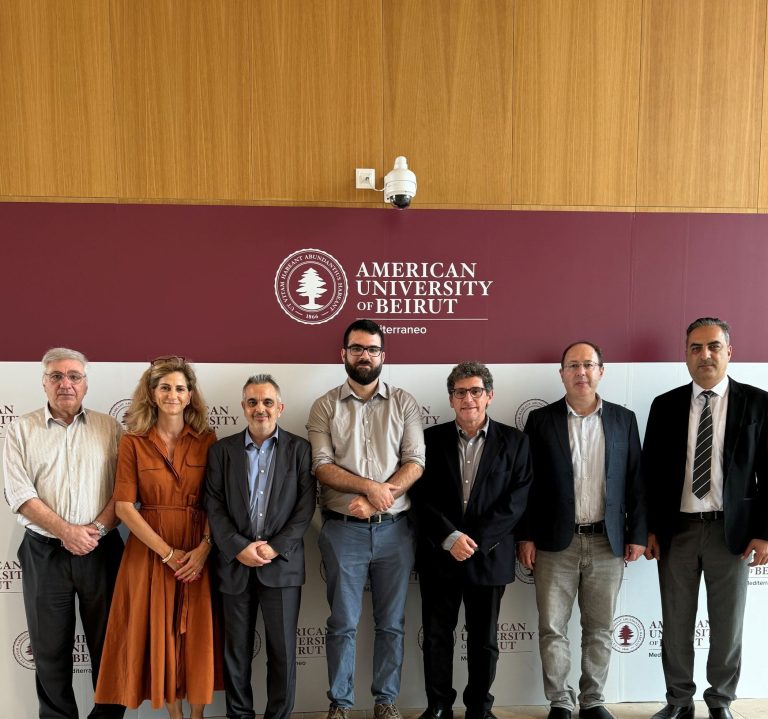
AUB Mediterraneo and Cyprus Symphony Orchestra Foundation Sign Memorandum of Understanding to Advance Music Education and Cultural Collaboration

AUB Mediterraneo Hosts Its First STEM Day in Pafos as Part of AUB’s STEM Week
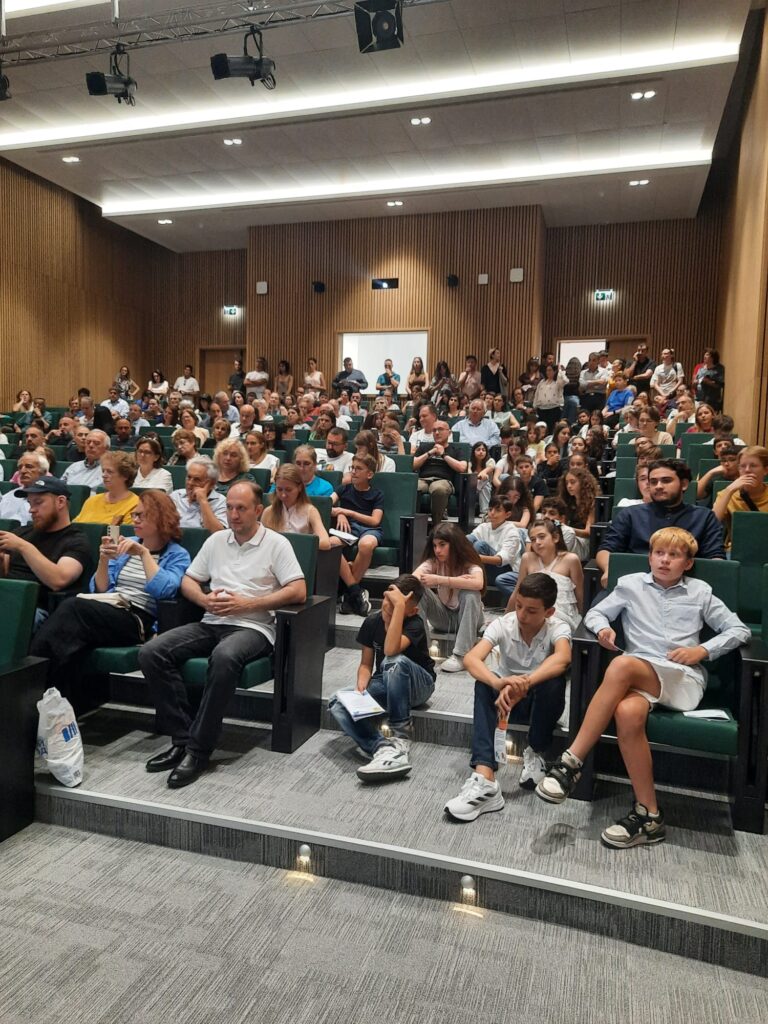
The Academy of Mathematical Excellence and Innovation begins classes

AUB Mediterraneo Launches Bachelor of Science in Computer Science and Engineering (CSE)
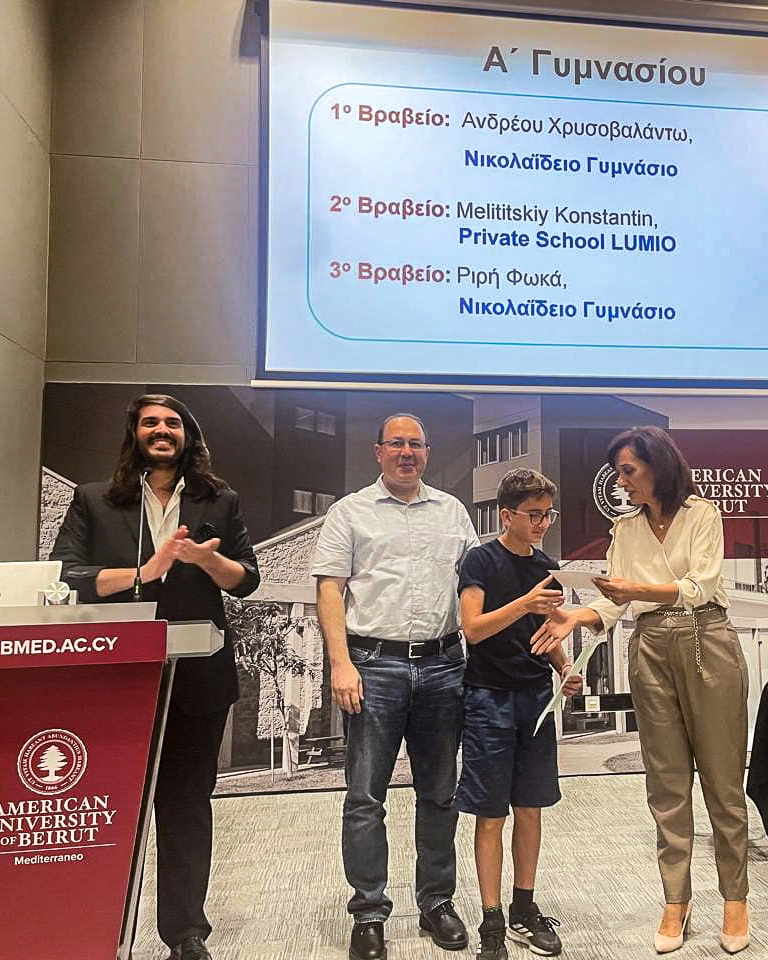
AUB Mediterraneo Hosts the Cyprus Mathematical Society Awards Ceremony
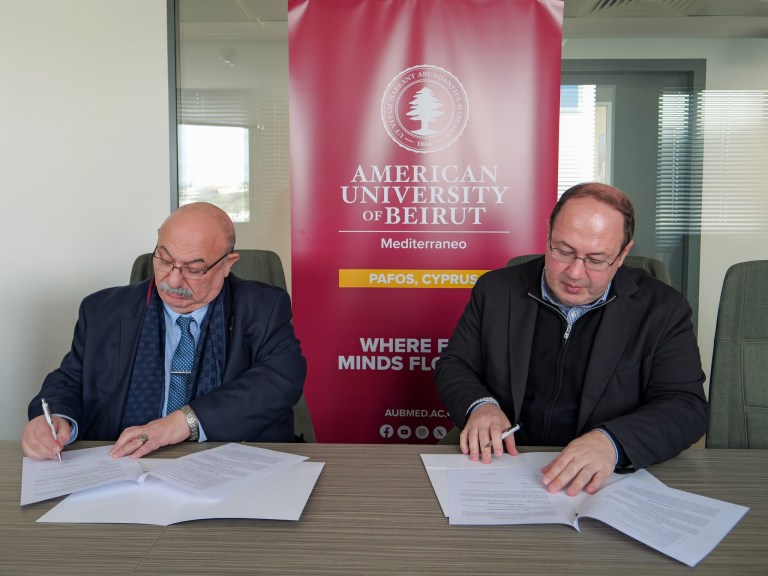
AUB Mediterraneo and Cyprus Mathematical Society Sign MoU to Advance Mathematics Education and Research
Research Projects

Frequently Asked Questions
What does a liberal arts approach to education mean and what are liberal arts classes like?
A liberal arts approach emphasizes broad learning alongside depth in a chosen field of study. Students are encouraged to explore multiple disciplines, develop strong skills in writing, research, and critical thinking, and learn to connect ideas across fields. Rather than focusing narrowly on job-specific training, a liberal arts education prepares students to adapt, think independently, and engage thoughtfully with complex social, scientific, and ethical issues throughout their lives. Liberal arts classes are typically discussion-based and emphasize active participation rather than passive listening. Students are expected to engage with readings, contribute to class conversations, write regularly, and develop arguments through essays, projects, and presentations. Courses often encourage students to examine questions from multiple perspectives and to connect ideas across disciplines.
What is General Education, and why is it required? Will it delay my progress in my major?
General Education introduces students to multiple ways of thinking across the arts, humanities, social sciences, and sciences. It helps students build essential skills (e.g., effective communication, ethical reasoning, and analytical thinking) that support both specialized study and long-term professional growth. General Education courses are integrated into degree study plans and are designed to complement major requirements, so they do not delay students' progress. Many courses connect directly to students’ fields of study while broadening their academic perspective.
Are there opportunities for undergraduate research?
Yes. FAS emphasizes inquiry-based learning and offers opportunities for supervised undergraduate research. Students work closely with faculty mentors on research projects, often as part of their coursework or capstone experiences, usually in their fourth year.
What is the typical class size in FAS courses?
Classes at AUB Mediterraneo are intentionally kept small (our average class size is 16, with few classes bigger than 20-25), allowing for discussion-based learning, close interaction with faculty, and personalized feedback.
How much writing and reading is expected?
Students should expect regular reading, writing, and reflection across FAS courses. These practices are central to the liberal arts approach and help students develop strong communication and analytical skills.
How much work is expected outside of class?
For each course, students should plan to spend time outside of class on reading, writing, research, and assignments. This independent work is an essential part of the learning process and is factored into how courses are designed and credited. For a typical 6 ECTS course, students can expect a total workload of approximately 150–180 hours over the full term, which includes approximately 7–9 hours per week dedicated to reading, writing, research, assignments, and preparation for class. The exact workload may vary by course and discipline, but faculty design assignments to ensure that expectations are reasonable, clearly communicated, and aligned with course learning goals.
How does FAS prepare students for careers after graduation? Can FAS students pursue graduate or professional school?
FAS programs prepare students for a wide range of careers by developing transferable skills such as critical thinking, research, communication, ethical reasoning, and analytical problem-solving -- skills valued across many professions, including media, education, NGOs, public service, technology, and business. Students in interdisciplinary programs such as PPE (Philosophy, Politics, and Economics) and Global Liberal Arts (GLA) are prepared for diverse career paths. PPE graduates often pursue careers in law, public policy, government, diplomacy, consulting, international organizations, and research, while GLA graduates move into media, communication, advocacy, education, NGOs, and cultural or health-related fields. FAS graduates are also well prepared for graduate and professional study, including law, medicine, psychology, public policy, and academic research.
Are there pre-med or pre-professional pathways?
FAS offers flexible academic pathways that allow students to complete prerequisite coursework for professional programs while pursuing a liberal arts degree. This includes a premedical studies track.
What kind of academic advising is available?
Students receive structured academic advising throughout their studies. Advisors help with course planning, General Education requirements, and preparation for graduate study or careers.
How accessible are faculty members outside of class?
Faculty maintain regular office hours and actively mentor students. Close faculty–student interaction is a defining feature of the learning experience at AUB Mediterraneo.
Will my degree be recognized internationally?
Yes. All American University of Beirut – Mediterraneo degrees follow international standards and support graduate study and employment worldwide. Our programs are accredited by the New York State Education Department and the Cyprus Agency of Quality Assurance and Accreditation in Higher Education, and institutionally the university is accredited by the Middle States Commission on Higher Education (MSCHE), ensuring broad international recognition.
Can I study for a term or more at AUB in Beirut and transfer my credits?
Yes. Students can spend up to one full year (two terms) at the AUB campus in Beirut, including summers, and credits and grades earned at AUB are fully transferable (up to 68 ECTS). All courses students transfer must correspond to their program of study and be approved by their adviser in advance.
Are students required to spend time at the AUB campus in Beirut?
Yes. All students must complete the Beirut Residency, a required non-credit component of the General Education Program. Students may fulfill the requirement through approved pathways such as coursework, internships, civic engagement activities, research visits, or one or two term at AUB.
Is the curriculum identical to the curriculum at AUB in Beirut?
AUB Mediterraneo programs follow AUB academic standards, governance structures, and quality assurance processes, with aligned learning outcomes across campuses. While the curriculum is closely coordinated and built in consultation with AUB faculty and leadership, it is not always identical. Some programs and courses are uniquely designed for AUB Mediterraneo to respond to regional needs, EU frameworks, and emerging fields. This includes our BA in Philosophy, Politics, and Economics (PPE) and our BA in Global Liberal Arts (GLA). In many cases, courses have been adapted and enhanced to reflect our context while maintaining AUB’s academic rigor and international standards.
Contact Us
Have questions about our faculty or programs? Get in touch with us.
fas@aubmed.ac.cyAccreditations & Affiliations

